Signals of Compromise: How Your Devices Reveal More Than You Realize
The Quiet Conversation You Never Hear Every modern device you own—your phone, your watch, your car, even your earbuds—is constantly transmitting information. Not always maliciously. Not even intentionally. But those signals can be intercepted...
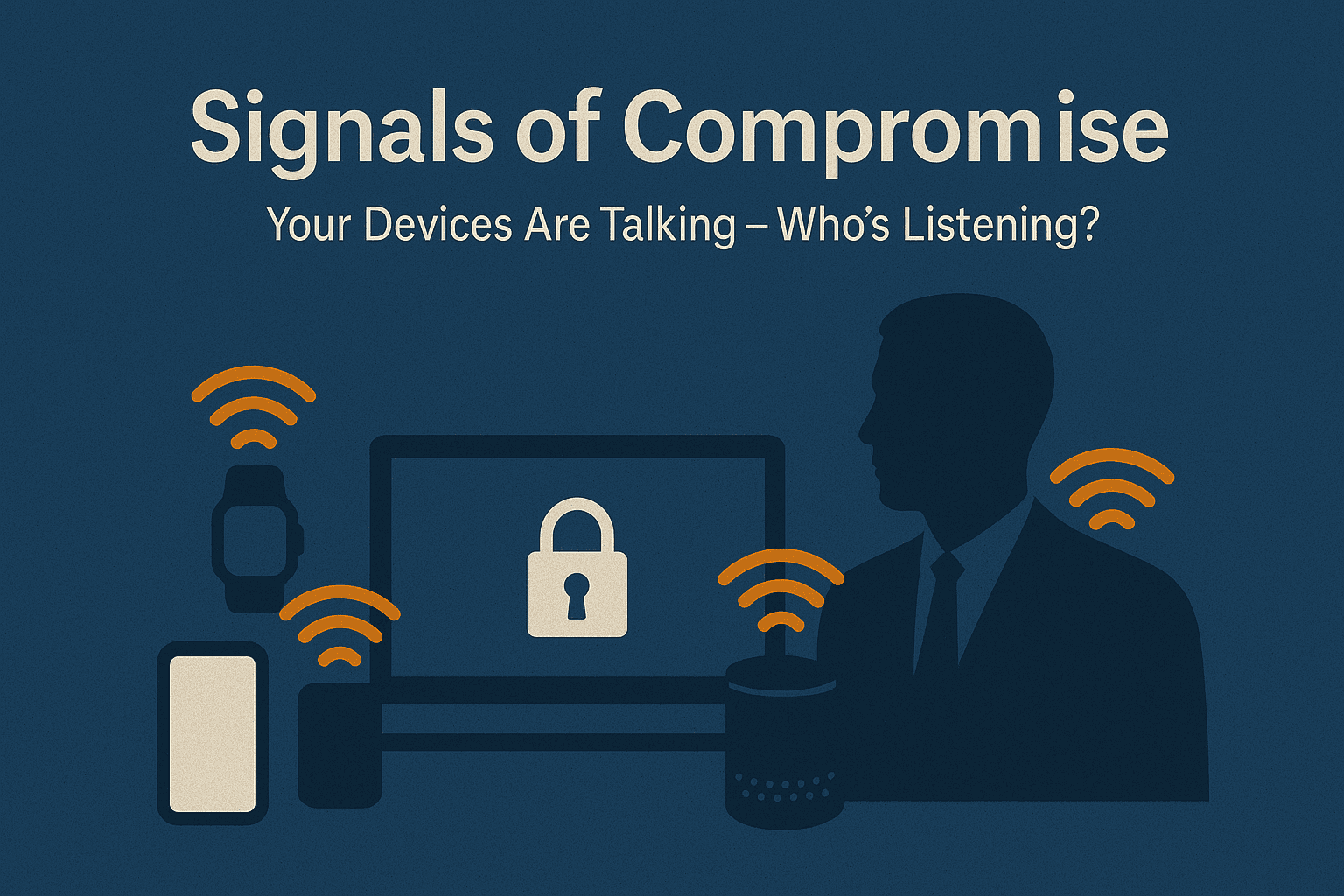
The Quiet Conversation You Never Hear
Every modern device you own—your phone, your watch, your car, even your earbuds—is constantly transmitting information.
Not always maliciously. Not even intentionally.
But those signals can be intercepted, mapped, and monetized.
For high-net-worth individuals, senior attorneys, and wealth managers, these invisible conversations pose a growing risk. Attackers don’t always need to breach your systems—they can simply observe your devices long enough to learn who you are, where you go, and what matters to you.
This is the modern surveillance economy: data extraction without intrusion.
The New Breach Vectors
1. Bluetooth and Wi-Fi Beacons
Every time your phone or smartwatch searches for a known network, it broadcasts a unique identifier.
Cybercriminals can track these identifiers to monitor your location patterns, hotel stays, or meetings—without ever touching your data.
2. Vehicle Telematics
Luxury cars now act as mobile data centers. They record destinations, calls, and even in-car voice commands. If your valet service, dealership, or connected-app credentials are compromised, your entire travel history can be reconstructed.
3. Biometrics and Facial Recognition
Your face and fingerprint data may be stored not just on your device, but in the systems of travel apps, border-crossing kiosks, or private clubs using biometric access. Once stolen, these identifiers can’t be “changed.”
4. Wearables and Health Devices
Your smartwatch knows when you wake, when you sleep, and how stressed you are. That data, sold to third parties or hacked from cloud dashboards, can reveal far more than a health report—it exposes lifestyle habits, physical locations, and even private relationships.
5. Voice Assistants and Smart Speakers
“Always listening” means always collecting. Many assistants continuously store snippets of audio data to improve recognition—snippets that sometimes include sensitive conversations.
Protecting What You Don’t See
Disable unnecessary radios: Turn off Bluetooth, NFC, and Wi-Fi when not in use.
Segment your devices: Use separate networks for phones, IoT devices, and home systems.
Review connected-car permissions: Disable remote access or require multifactor authentication for companion apps.
Use privacy screens and Faraday sleeves when traveling.
Revoke cloud sharing for biometrics and health data.
Employ active signal monitoring: Specialized tools can detect unauthorized connections or persistent tracking attempts.
The Concierge Approach to Digital Silence
At Valethorn Cybersecurity, we specialize in the quiet defense—the kind that protects not just your data, but your presence.
Our concierge service identifies passive data leaks across every digital layer of your life—devices, vehicles, networks, and homes—and implements mitigation strategies before adversaries can act.
We don’t simply stop hackers; we stop patterns—the invisible digital fingerprints that make high-profile individuals traceable targets.
Because true privacy isn’t about disconnection—it’s about selective visibility.
Final Reflection
You don’t need to be online to be observed.
Every light that turns on, every car that starts, every device that listens creates a signal—and signals tell stories.
Control the story before someone else writes it for you.